Ultimately, the last piece ended on a line: Agency that has been authorized, not agency that has to be supervised. The substrate is here, and the protocols are ready. However, moving from a philosophical claim to deployable AI agent infrastructure requires a stack, not just a chain.
Therefore, this is that stack and the precise shape it has to take to be useful. The rest of this piece walks through the layers of AI agent infrastructure that actually work, alongside the two that the market predictably keeps under-shipping.
Key Takeaways
- AI agent infrastructure needs four primitives, not three: identity, wallet, payments, and policy.
- Externally Owned Accounts cannot scope permissions, expire credentials, or sponsor their own gas. Consequently, this makes them unsafe for autonomous agents.
- Through ERC-4337 and EIP-7702, the wallet turns into a programmable contract that can enforce spend caps and rotate keys.
- While the market has built Wallet and Payments, Identity (ERC-8004) and Policy remain the underbuilt half.
- The Abstraxn Agent Layer ships all four powers on infrastructure currently securing $5B+ in volume.
Why EOAs Fail as AI Agent Infrastructure
First, let’s start with the wallet, because that is where most agent-and-money attempts break. Externally Owned Accounts, which most of crypto still relies on, are fundamentally hostile to agents.
These accounts are tied to a single private key. Consequently, they cannot enforce spending limits or rotate permissions. Furthermore, standard EOAs are unable to pay their own gas, nor can they validate logic before signing.
In practice, handing an EOA’s private key to an autonomous agent is the digital equivalent of giving a teenager your credit card, your car keys, and your house alarm code, then leaving for a two-week vacation. Naturally, the agent can act. Unfortunately, so can anyone who pulls the key off a compromised machine. Because there is no scoping, no expiry, and no audit trail at the protocol level, the wallet simply does what the key tells it.
Ultimately, that is not autonomy. Instead, it is unsupervised exposure with extra steps.
How Account Abstraction Powers AI Agent Infrastructure
Fortunately, smart accounts under ERC-4337 and EIP-7702 stop treating the wallet as a passive keypair. Rather, they make it a highly programmable contract.
As a result, you can attach policies, scope permissions, and rotate keys without losing the account entirely. Additionally, you can batch operations or let a third party (a paymaster) sponsor gas in any currency—or even in no currency at all.
Specifically, session keys are the crucial unlock for agents. These are short-lived, narrowly scoped credentials that let an agent act inside defined limits, expiring automatically the moment the job is done. Accordingly, the agent signs a UserOperation, a bundler picks it up, and the Abstraxn Paymaster sponsors the gas if the rules allow it.
Thus, the wallet stops being a credit card with no back-of-house controls. Instead, it becomes infrastructure that knows exactly how to say no.
However, the wallet is merely one primitive. To function properly, AI agent infrastructure actually needs four.
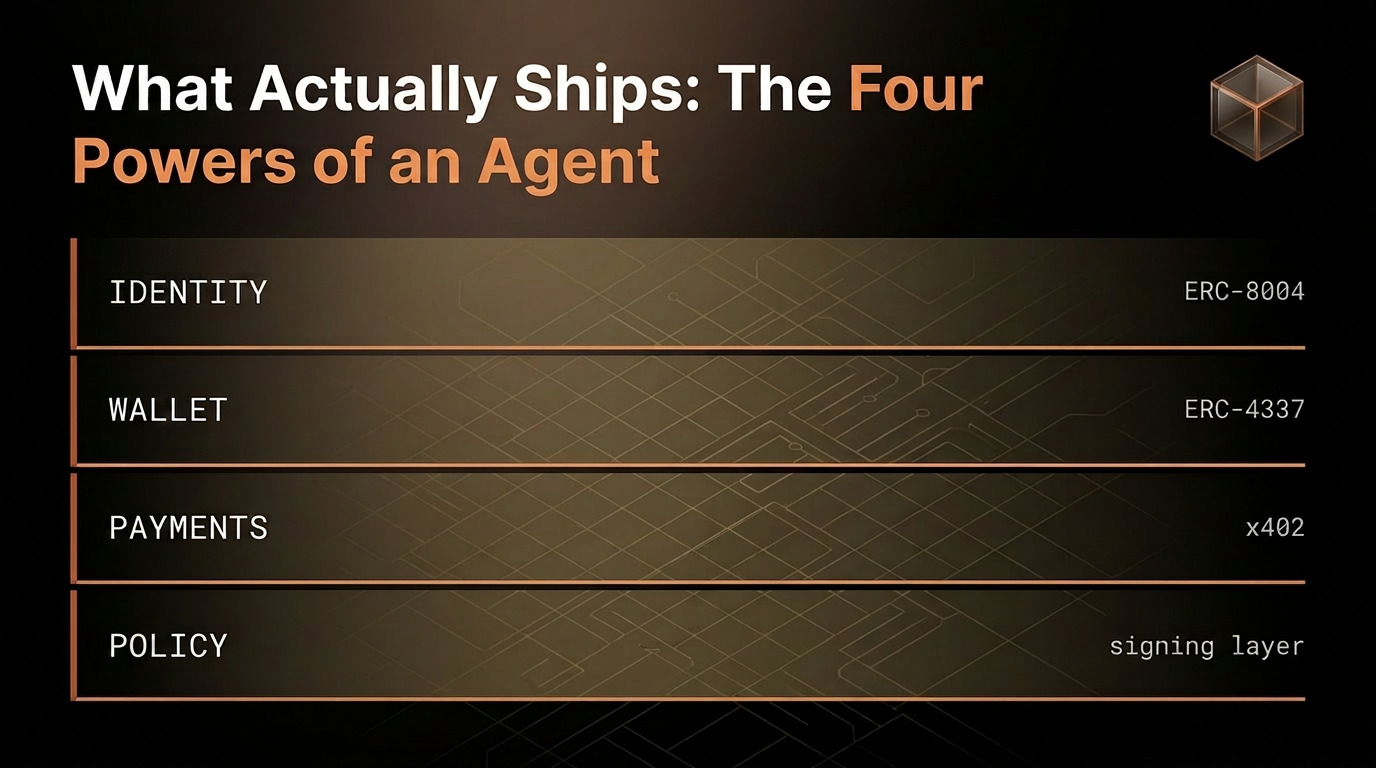
The Four Powers of AI Agent Infrastructure
If you strip away the framing, an autonomous, non-human actor needs exactly four things to function seamlessly. Not three. Moreover, the shape of this gap heavily matters.
1. Identity
First and foremost, the agent has to be addressable, verifiable, and accountable across protocols. It cannot just be a wallet address that anyone could spin up in thirty seconds. Instead, it requires a persistent on-chain presence with reputation, provenance, and a way for the rest of the network to know which agent it is dealing with. Currently, ERC-8004 is the standard taking shape around this exact question.
2. Wallet
Secondly, we have the smart account itself, powered by ERC-4337 and EIP-7702. Essentially, this serves as the home address for the agent’s value, acting as the primary substrate that every other power plugs into.
3. Payments
Next are the rails that match how agents actually transact. Unlike human users, agents do not make one big purchase a day; instead, they execute hundreds of micro-settlements an hour against APIs, marketplaces, and other agents. For instance, x402 allows for HTTP-native payment flows where the agent pays for a data feed in the same call that fetches it. Meanwhile, MPP manages multi-party settlement when more than two actors are clearing value in a single operation. Ultimately, the agent pays for the data feed before receiving the data, since the data feed will not extend it credit.
4. Policy
Finally, there is the layer that decides whether a given transaction is allowed to happen at all. Crucially, this is enforced at signing, before the agent can even act. Examples include spend caps, allowlists, time windows, and an audit trail that a compliance team can actually read. In short, these are guardrails that live securely in the infrastructure, rather than in a prompt you are merely hoping the model respects.
Historically, the industry has crowded into Wallet and Payments. As a result, money in and money out is broadly solved. In contrast, Identity and Policy represent the underbuilt half. Furthermore, they are the specific half that decides whether agents actually go into production or permanently stay in demos.
The Abstraxn Agent Layer: AI Agent Infrastructure in Production
To illustrate this shift, here is what production AI agent infrastructure looks like at Abstraxn today.
First, we provide a dashboard that deploys a fully wallet-equipped, transaction-capable agent in minutes, rather than months.
Furthermore, every agent gets a native Abstraxn smart account with session keys, spend policies, and recovery baked in from day one. Since key management runs on Abstraxn WaaS, teams do not have to roll their own custody, and end-users similarly do not have to think about seed phrases.
Additionally, the Abstraxn Paymaster is wired in by default. Consequently, agents transact gaslessly across supported chains, either sponsored or self-funded based on the specific rules the team defines.
Moreover, the dashboard ships with 50+ pre-integrated MCPs (Model Context Protocol servers). This immediately gives every agent reach into marketplaces, data feeds, DeFi protocols, and off-chain APIs without having to write custom integration glue.
Likewise, a growing catalog of ready-to-use tools—such as price oracles, swap routers, identity verifiers, and settlement helpers—lets agents compose real workflows right out of the gate.
Most importantly, all of this sits on the exact same Abstraxn stack already securing $5B+ in volume across 100k+ transactions for 50+ integrations, boasting 99.99% uptime. Therefore, the infrastructure is completely battle-tested. We are simply exposing the right shape of it for what is rapidly becoming the largest user category in Web3: the agent itself.
The Bigger Picture
Historically, the first wave of the internet taught machines to talk to each other. Subsequently, the second wave taught them to serve content to humans. Now, the third wave—the one we are currently standing at the edge of—is about machines transacting with each other on behalf of humans, doing so at speeds and scales that human-mediated commerce simply cannot reach.
Naturally, that world will not run on Web2 rails. Moreover, it cannot function on EOAs. Ultimately, it will not survive on infrastructure built for one human, one credit card, and one checkout button at a time.
Instead, it runs on programmable wallets, sponsored gas, session-scoped authority, and identity that holds across protocols. Above all, it requires a policy layer that enforces trust before the signature, rather than after the loss. The Agent Layer is currently live at dashboard.abstraxn.com. Go ahead, spin one up, and send it after something.
The agents are coming. Build accordingly.
Frequently Asked Questions
What is account abstraction?
Account abstraction is an Ethereum standard (primarily ERC-4337, with EIP-7702 as a complementary upgrade) that turns a wallet from a passive keypair into a programmable smart contract. Furthermore, it enables spending limits, key rotation, gas sponsorship, batched operations, and policy enforcement at the protocol level.
Why do AI agents need smart accounts instead of regular wallets?
Externally Owned Accounts tie all authority to a single private key. Consequently, they cannot scope permissions, enforce spending limits, or expire credentials automatically. Handing an EOA’s key to an autonomous agent removes every safeguard at once. In contrast, smart accounts let agents act strictly inside cryptographically enforced limits.
What are the Four Powers of an autonomous agent?
The four core powers are Identity, Wallet, Payments, and Policy. Specifically, Identity makes the agent addressable and accountable across protocols (ERC-8004). The Wallet gives it a programmable on-chain presence (ERC-4337, EIP-7702). Payments handle transaction rails, including micro-settlement (x402, MPP). Finally, Policy enforces vital guardrails like spend caps and allowlists prior to signing.
What is ERC-8004?
ERC-8004 is the emerging standard for agent identity and reputation on Ethereum. Ultimately, it defines how autonomous agents can be addressable, verifiable, and accountable across protocols, extending far beyond a basic wallet address that anyone could spin up in thirty seconds.
What is x402?
x402 is an HTTP-native payment protocol that lets agents seamlessly pay for resources in the exact same call that requests them. Consequently, it is designed for high-frequency micro-settlement between agents and APIs, which standard payment rails simply cannot support.
What is AI agent infrastructure?
AI agent infrastructure is the layered technical stack that lets autonomous AI agents act on-chain without human intervention. Crucially, it consists of four primitives: identity, wallet, payments, and policy. Each is governed by a specific protocol: ERC-8004 for identity, ERC-4337 and EIP-7702 for wallet, x402 and MPP for payments, and programmable signing-layer guardrails for policy.
What is the Abstraxn Agent Layer?
The Abstraxn Agent Layer is an advanced dashboard that deploys wallet-equipped, transaction-capable AI agents in minutes. Accordingly, every agent gets a smart account, paymaster integration, 50+ pre-integrated MCPs, and a tool catalog, all securely hosted on infrastructure managing $5B+ in volume across 100k+ transactions.