
The Crocodile on Land: Why Agentic Payments Cannot Live on Web2
Scroll the timeline of any major player right now (Google, Microsoft, Meta) and the narrative is identical. Agentic AI. The market is aggressively bullish, and there is a reason VCs are burning dry powder to back AI startups at valuations that look like typos.
Almost every third startup funded today has an AI use case, and the deepest infrastructure bets sit inside agentic payments. Half of them pitch ideas so absurd you wonder if pitching them to fund your tuition would land better. If someone is funding an autonomous agent to tell you when your carrots are ready to be pulled from the soil, there is probably a check waiting for you too.
But the madness has a method. VCs know that for every hundred startups they back, the one or two that actually nail the infrastructure will return the whole fund. And right now, the most lucrative, foundational corner of this space is agentic payments.
Information is digital gold, and it is not 2010 anymore. You are not finding everything you need for free on Wikipedia. Almost every valuable API, dataset, and service today sits behind a paywall. For autonomous agents to actually be autonomous, they have to navigate and clear those paywalls on their own.
The Web2 Force-Fit
Watching legacy tech firms try to bolt agentic capabilities onto Web2 infrastructure is honestly worth a laugh. Not to underplay the engineering effort. We are seeing serious pushes like Google’s AP2 (Agent Payments Protocol) trying to solve this with Intent Mandates and Cart Mandates.
But the friction is not the software. It is the inherent nature of Web2. The legacy web simply was not built to empower non-human actors.
Trying to force agentic AI onto Web2 rails, where systems demand OAuth, KYC, and credit card verification, is like pulling a crocodile out of the water and optimizing its hunting skills on land. You are not removing limitations. You are actively stripping away its native strengths by forcing it into an environment fundamentally hostile to its architecture.
Nate’s PlayStation, Web2 Edition
To get this out of the abstract: a user named Nate wants to buy a PlayStation.
In the manual era, Nate goes to Amazon. He checks prices, reads Reddit reviews, cross-references eBay for second-hand units, clicks Add to Cart, verifies his identity, enters his card, and the transaction clears. Slow but workable.
Now it is the 2020s and Nate has an agent. He tells his Web2 AI agent to find the cheapest PlayStation. The agent spins up. It calls sub-agents, scrapes prices, analyzes the best time to execute, ensures it is inside Nate’s guardrails, and proceeds to checkout.
Then the gateway freezes. “Wait. How do I know you are Nate? Prove it. Solve this CAPTCHA. Authenticate this session. Provide a 2FA code.”
The agent, despite all its processing power, hits a dead end. It requires human intervention to click the final button. The autonomy collapses at the exact moment it was supposed to be worth something.
Why Agentic Payments Need Web3 Rails
Web3, by design, is built for this kind of operation. When you shift to decentralized rails, the friction evaporates. Through L2 architectures and protocols like x402, smart contracts act as deterministic, programmable APIs.
Agents spin up their own wallets, hold value, and execute micro-transactions at millisecond speeds using cryptographic signatures. They do not need a bank to trust them. They need valid logic and sufficient gas. Web3 is not an alternative substrate for agentic AI. It is the only permissionless track where these systems function as first-class citizens.
Nate, Reimagined
Run the same problem on Web3 rails.
Nate’s agent scrapes prices, hunts listings, cross-references threads, evaluates seller reputation, and lands on the best deal. This time it is not a passenger trying to drive a vehicle built for someone else. It owns a smart account, governed by a session key Nate signed off on with hard guardrails: spend no more than $600, only on verified hardware listings, only within the next 24 hours.
When the moment to transact arrives, there is no CAPTCHA. No 2FA. No frozen checkout. The agent constructs a UserOperation, signs it with its session key, submits it to a bundler, and a paymaster picks up the gas so nobody has to think about token balances. The transaction settles in seconds. Nate gets a notification: PlayStation purchased, $548, delivery in 3 days.
The agent did not have to ask permission at the final mile because the permission was already encoded into the wallet itself, at the protocol level, the moment Nate scoped the session.
The Line Nobody Talks About
That is the philosophical difference. Agency that has to be supervised, versus agency that has been authorized.
Web2 was built around the first model. Every system in it assumes a human is one click away, ready to prove they are real, ready to consent again. Web3, properly used, is the first stack ever built around the second. Permission as a configuration, set once, enforced forever by a contract that does not blink.
That is the line the agentic conversation keeps stepping over. Frameworks and LLMs have largely solved planning and tool-calling. What they have not solved is agentic payments: giving an autonomous, non-human actor a financial primitive it can actually use without a human looming behind it.
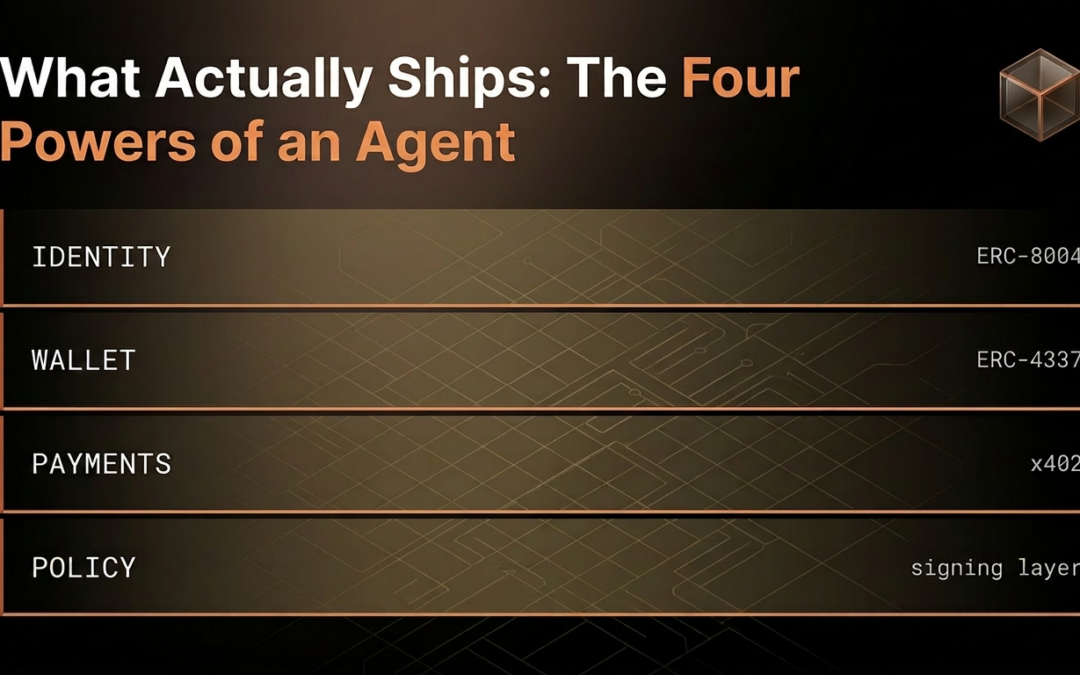
The substrate is here. The protocols are here. But shipping an agent that actually transacts requires more than a chain underneath. It requires a stack. The wallet, the gas sponsor, the identity layer, the policy engine, and the tools the agent reaches for, all stitched together so a builder does not have to assemble seven primitives by hand before the agent does anything useful.
That stack has a name now, and a shape worth arguing about. We will get to it in the next piece.