
Transaction flows in Web3 still depend on repeated user approvals.
Each interaction requires a signature.
Each step introduces friction.
Each interruption breaks continuity.
This model limits how applications can operate at scale.
They reduced dependence on direct user interaction for every step. Session keys extend this model further.
They allow applications to execute transactions within predefined boundaries, without requiring repeated approvals.
This enables one-click actions while maintaining controlled execution.
Session keys are not a UX enhancement. They are part of the execution infrastructure required for continuous interaction.
The Limitation of Repeated Signatures in Web3 Applications
Traditional transaction models are signature-driven.
The user must explicitly approve every action.
This creates predictable security guarantees. It also introduces operational constraints.
In multi-step workflows:
- Each step requires confirmation
- Execution is interrupted repeatedly
- User attention becomes a dependency
For applications, this results in:
- Fragmented interaction flows
- Higher drop-off rates
- Limited ability to automate execution
Even with smart accounts, requiring signatures for every action restricts continuity.
Execution remains partially user-dependent.
What Are Session Keys in ERC-4337 Systems
Session keys are temporary, scoped signing permissions assigned to a smart account.
They allow predefined actions to execute without requiring a full account signature each time.
In ERC-4337 systems, session keys operate as delegated authorization mechanisms:
- The primary account grants limited permissions
- A secondary key executes actions within those constraints
- Permissions are enforced at the account level
Session keys are:
- Time-bound
- Permission-scoped
- Revocable
They do not replace account ownership.
They extend how execution is authorized.
ERC-4337 Session Keys as Execution Infrastructure
ERC-4337 session keys function within the smart account validation layer.
They are enforced through account-level logic rather than external systems.
This enables:
- Session-based authorization
- Controlled execution without repeated signatures
- Deterministic validation before submission
From an infrastructure perspective, session keys:
- Reduce signature dependency
- Maintain execution control
- Align authorization with application logic
Execution remains verifiable.
Control remains enforced through predefined policies.
How Web3 Session Keys Enable One-Click Actions
One-click actions are not achieved by removing validation.
They are achieved by predefining it.
Session keys allow applications to:
- Authorize a set of actions during session creation
- Execute those actions without further prompts
- Enforce constraints during execution
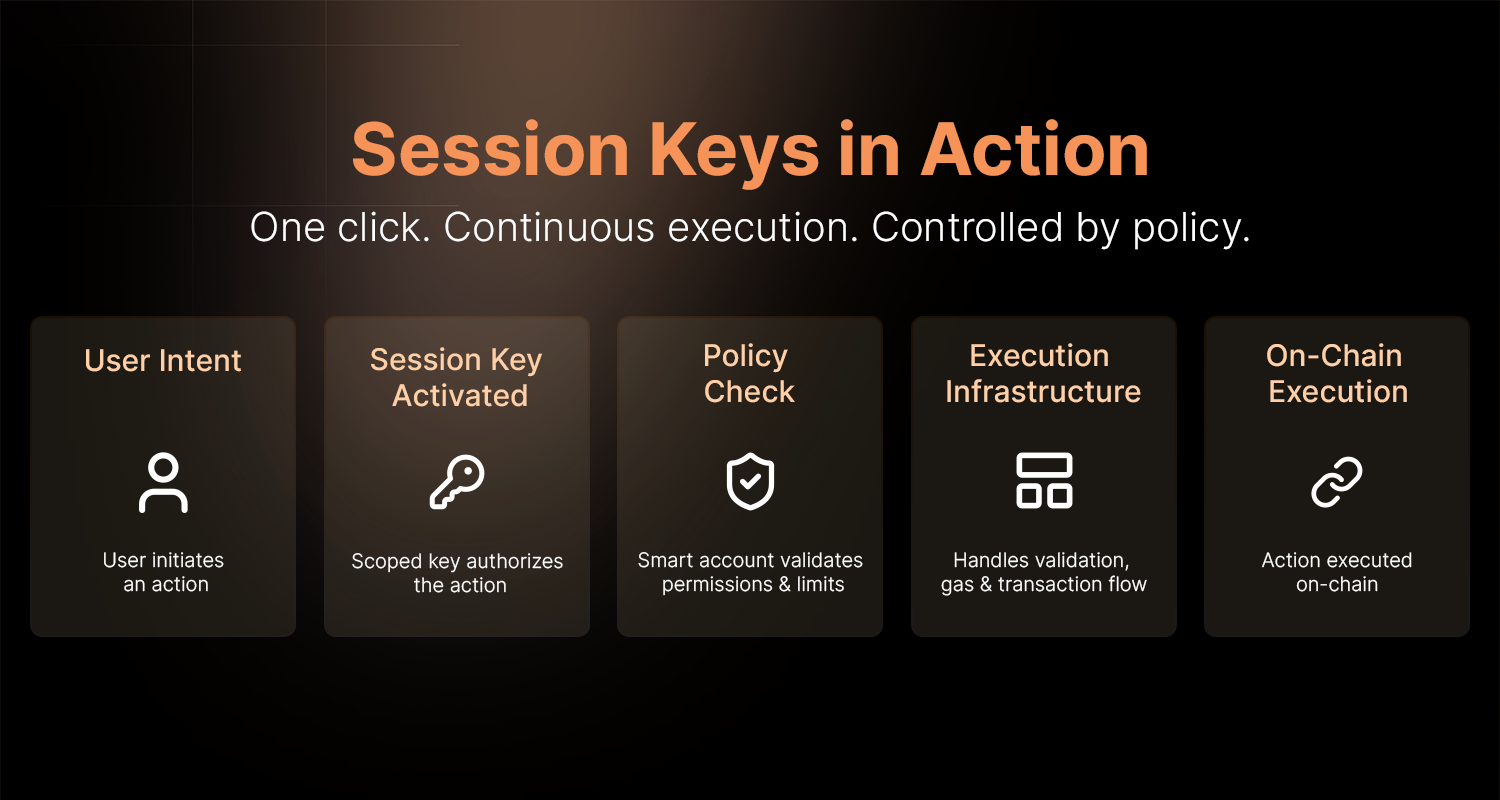
A typical flow:
- User authenticates inside the application
- A session key is issued with defined permissions
- The user performs actions without repeated approvals
- The session expires or is revoked
From the user perspective:
- The interaction becomes continuous
- Execution appears instant
- Prompts are minimized
From the system perspective:
- Every action remains validated
- Permissions are enforced deterministically
Permission Design in Session Keys
Session keys depend on clearly defined constraints.
Permissions typically include:
- Allowed contract interactions
- Spending limits
- Session duration
- Operation types
This creates a bounded execution environment.
Instead of asking for approval each time, the system evaluates:
- Whether the action fits within the session scope
- Whether constraints are satisfied
If conditions are met, execution proceeds.
If not, the request is rejected before submission.
This model shifts validation from user interaction to system enforcement.
Security Model of ERC-4337 Session Keys
Session keys introduce a different security model.
Security is no longer based on repeated signatures.
It is based on constrained delegation.
Key properties:
- A limited scope reduces exposure
- Expiration prevents long-term misuse
- Revocation enables immediate control
Risk is contained within predefined boundaries.
Even if a session key is compromised:
- Actions are restricted
- Duration is limited
- Policies prevent unrestricted access
This approach aligns with production systems where:
- Continuous interaction is required
- Strict control must be maintained
Execution Infrastructure Behind Session Keys
Session keys operate within a coordinated execution system.
They depend on multiple infrastructure components:
Smart accounts: Define validation logic and enforce session rules.
Bundlers: Process and submit operations for execution.
Paymasters: Handle gas abstraction within session flows.
Relayers: Support controlled transaction routing where required.
These components ensure:
- Consistent processing of session-based operations
- Predictable execution outcomes
- System-level enforcement of permissions
Session keys define authorization.
Infrastructure ensures execution.
Where Session Keys Fit in Web3 Wallet Infrastructure
Session keys extend wallet infrastructure beyond onboarding and execution.
They introduce a third layer: continuous interaction.
Within a production architecture:
- Embedded wallets handle onboarding
- Smart accounts define execution logic
- Session keys enable uninterrupted interaction
This allows applications to:
- Maintain user sessions across actions
- Reduce interaction friction
- Support high-frequency workflows
Execution becomes aligned with application behavior rather than user intervention.
Abstraxn’s Approach to Web3 Session Keys
Abstraxn integrates session keys within its smart account and execution infrastructure.
Session-based authorization operates alongside:
- Embedded wallet onboarding
- Authentication systems
- Execution infrastructure for smart accounts
From an integration perspective:
- Session policies are defined at the account level
- Execution follows the same deterministic infrastructure
- Developers interact through SDKs without managing session mechanics
This allows applications to:
- Enable one-click actions within controlled environments
- Maintain consistent execution behavior
- Reduce dependency on repeated user approvals
Session keys operate as part of a unified system, not as an isolated feature.
Conclusion
Repeated approvals limit how Web3 applications operate.
They introduce friction, reduce continuity, and constrain execution design.
Session keys address this by introducing controlled, session-based authorization.
Execution becomes:
- Continuous
- Policy-driven
- Infrastructure-managed
Smart accounts define the rules.
Session keys extend how those rules are applied.
Infrastructure ensures reliable execution.
For applications building production systems, one-click interactions are not a UI improvement.
They are the result of a controlled execution infrastructure.
Session keys make this possible while maintaining security, predictability, and system-level control.