Once onboarding is handled inside the application, developers stop thinking about wallets as user decisions and start treating them as infrastructure.
In the previous posts, we covered why embedded wallets have become the baseline for Web3 onboarding and how authentication can be handled using familiar login methods without external wallet prompts. This guide moves one step closer to implementation. It explains how embedded wallets fit into a React application, what changes operationally compared to extension-based flows, and where this model becomes necessary as applications scale.
This is not a tutorial. It is a fast orientation for React developers evaluating embedded wallets as part of their onboarding stack.
Embedded Wallets for React Devs: What Changes in Practice
Embedded wallets move wallet creation inside the application lifecycle.
Instead of asking users to connect an external wallet, the application provisions a wallet programmatically when a user signs in. Authentication and wallet creation happen together, and the user enters the product without leaving the app or installing extensions.
From a React developer’s perspective, this changes three things immediately:
- Wallet state becomes application state
- Authentication and wallet provisioning are unified
- Onboarding logic stays inside the React component tree
The wallet still exists. Keys still exist. What changes is exposure. Wallet mechanics are no longer the first interaction users face.
For teams building beyond crypto-native audiences, this distinction is operationally significant.
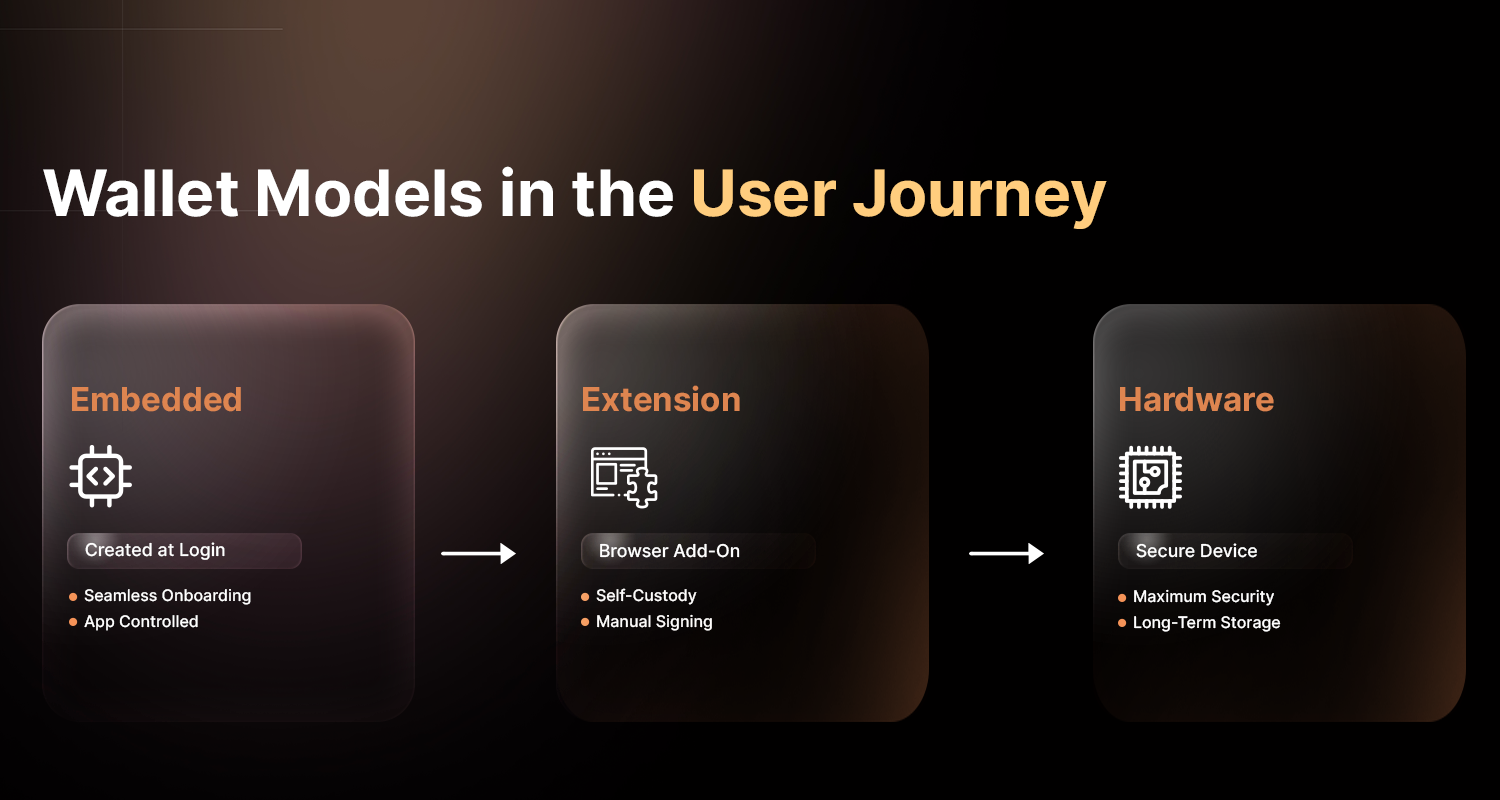
Embedded Wallets vs Extension Wallets vs Hardware Wallets
Choosing a wallet model is not about preference. It is about where each model fits in the user journey
Embedded wallets
Embedded wallets are created inside the application at login. They are designed for onboarding, session continuity, and predictable UX. Users do not manage keys on day one. The application owns the flow.
Extension wallets
Browser wallets are optimized for self-custody and composability. They work well once users are already engaged. As entry points, they introduce context switching, UI fragmentation, and early signing requirements.
Hardware wallets
Hardware wallets maximize asset security. They are not onboarding tools. They belong later in the lifecycle, when users are managing significant value.
Modern applications increasingly combine all three. Embedded wallets handle entry. Extension and hardware wallets become optional upgrades once users are active.
This layered approach avoids forcing advanced security decisions at the moment of first interaction.
Embedded Wallets as a Service for React Applications
Most teams do not want to build wallet infrastructure.
Key management, secure provisioning, session recovery, and execution reliability are not React concerns. They are infrastructure concerns. This is where embedded wallets as a service becomes the practical model.
In a Wallet-as-a-Service architecture:
- Wallet provisioning is handled via SDK
- Authentication providers are configured centrally
- Wallet lifecycle is managed outside the application code
- The React app consumes a clean, predictable interface
For developers, this removes the need to reason about cryptography while retaining control over UX and application logic. The wallet system integrates into the app instead of sitting beside it.
Account Abstraction, Gas Fees, and Embedded Wallet Flows
Embedded wallets make account abstraction usable.
When onboarding is controlled by the application, developers can introduce gas abstraction and execution policies without exposing complexity to users. Gas fees stop being a blocking concern during first interaction.
In embedded wallet flows:
- Transactions can be sponsored selectively
- Gas logic can be abstracted behind execution infrastructure
- Users interact with the product before encountering blockchain mechanics
This is why account abstraction and gas sponsorship typically appear after embedded wallets are in place. Without controlled onboarding, abstracting gas becomes brittle and inconsistent.
This becomes increasingly relevant once applications move beyond basic interactions.
What a 5-Minute Integration Actually Looks Like in React
“Five minutes” means first wallet provisioned, not production finalized.
In practice, React integration follows a simple pattern: install the SDK, initialize it at the app boundary, and invoke wallet creation on login.
Snippet 1: SDK initialization
import { AbstraxnProvider } from “@abstraxn/react”; export function App({ children }) { return ( {children} ); }
This establishes wallet infrastructure at the application level. Authentication and wallet provisioning now live inside the app boundary.
Snippet 2: Wallet provisioning on login
import { useWallet } from “@abstraxn/react”; function LoginButton() { const { login } = useWallet(); return ( ); }
On first login, a wallet is created automatically. On subsequent logins, the same wallet is retrieved. No extension prompts appear. No signing loop interrupts the flow.
From the component’s perspective, authentication returns a session with an associated wallet.
Where Abstraxn Fits in a React Onboarding Stack
Abstraxn implements embedded wallets as onboarding infrastructure, not UI components.
For React applications, this means:
- Wallets are provisioned programmatically
- Authentication uses familiar methods like email or passkeys
- Wallet UX remains inside the app
- Smart account capabilities can be introduced progressively
Wallet creation, authentication, and execution remain predictable and fully under developer control. External wallets can be enabled later without changing core onboarding logic.
This allows teams to treat onboarding as a stable system rather than a fragile integration of third-party tools.
What Comes After Embedded Wallets
Embedded wallets solve entry. They do not solve execution complexity.
Once users transact regularly, developers encounter new constraints:
- Multi-step transaction flows
- Gas optimization requirements
- Execution reliability at scale
This is where smart accounts, transaction batching, and relayed execution become necessary. These capabilities build cleanly on top of embedded wallet onboarding.
Once onboarding is handled, execution becomes the real bottleneck.
That is where the series continues.
Closing Perspective
Embedded wallets are not a shortcut. They are the baseline.
For React developers building production Web3 applications, embedded wallets turn onboarding into infrastructure. Authentication becomes predictable. Wallet creation becomes automatic. UX ownership stays with the product.