

Agentic Banking Infrastructure API: What It Is and How to Build On It
Discover how an agentic banking infrastructure api enables autonomous agents to hold value, pay fees, and execute internet native payments securely without human intervention.

Agentic Banking Infrastructure API: What It Is and How to Build On It
Artificial intelligence is undergoing a foundational shift. Autonomous agents are moving rapidly from text-based analysis to active execution within live operational workflows. The instant an autonomous agent needs to purchase a digital resource, allocate corporate capital, or manage liquidity, it encounters a legacy barrier: traditional human-facing financial infrastructure is not built for software. To operate independently, these autonomous ai systems require a dedicated agentic banking infrastructure api that allows software to safely hold value, interact with data sources, and execute payments.
1. What is agentic banking infrastructure?
Agentic banking infrastructure is the specialized architecture layer that connects autonomous agents directly to programmable financial systems. This infrastructure exposes secure tools that allow software entities to read financial state, verify counterparty account ownership, and execute transactions without direct human intervention at the point of checkout.
Traditional human banking APIs, card processors, and bank aggregators are fundamentally unsuited for autonomous ai systems. Legacy systems operate under assumptions that no longer apply to software:
- Human in the loop dependencies: Traditional financial rails assume a human user is present to solve a CAPTCHA, input a one-time password, or manually sign a transaction interface.
- Misaligned compliance and identity: Know Your Customer frameworks are legally structured around human identities and physical government IDs, offering no clear path for non-human identities to open traditional bank accounts.
- Key custody and security gaps: Traditional setups lack secure runtime mediation protocols designed to let software independently manage cryptographic signatures or interact safely with transaction environments.
- Frequency and latency mismatches: Legacy processing networks charge fee structures and run on settlement times optimized for human frequencies, failing entirely when an agent needs to execute thousands of micro-transactions per hour.
When artificial intelligence acts on behalf of an enterprise to execute a multi step plan, the underlying network must move money at machine speed. True agentic infrastructure resolves this friction by translating intent-driven natural language commands into structured, permission-bound programmatic actions.
2. The core primitives of an agentic banking stack
Building an enterprise-ready environment for agentic ai payments requires a vendor-neutral conceptual scaffold. This system-level backbone ensures that any transaction initiated by an agent remains bounded, auditable, and secure. The stack is split into five core technical layers:
The Account Layer
Autonomous agents cannot store capital in a standard bank vault. Instead, they require programmable smart accounts. Built on programmatic frameworks like account abstraction, these digital containers hold stablecoin balances or network tokens. The agent controls the account within strict boundary parameters, separating the application's reasoning layer from absolute asset ownership.
The Transaction Rails
Once an agent initiates a transaction, specialized blockchain relayers, bundlers, and paymasters act as the execution engine. Bundlers pack user operations into cohesive batches to optimize throughput on high-performance networks like Solana and Ethereum Layer 2 systems. Paymasters handle execution costs, allowing third-party sponsors to cover fees so the agent does not have to hold volatile native network tokens.
Agentic Identity
Every autonomous system must maintain a cryptographically verifiable agentic identity. Unlike long-lived static infrastructure secrets, this identity functions as a dynamic, ephemeral principal at runtime. It maps the chain of custody from the human owner down to the sub-agent, providing concrete answers to who authorized a specific action.
Agentic Policy
An autonomous agent must never be granted unrestricted data access or unbounded capital authority. An embedded agentic policy serves as the operational guardrail. It codifies deterministic business rules, spending caps, time-bound access limits, and strict restrictions on allowed tool integrations. If an agent encounters an edge case that violates the policy, the system halts execution and triggers a human oversight threshold.
The API Surface
The integration plane exposes these financial capabilities to developer environments. Through standardized frameworks like the Model Context Protocol, the API connects the agent's large language model directly to financial tools, abstracting the underlying cryptographic complexity behind clean developer tools.
3. What to look for in an agentic banking infrastructure API
When evaluating infrastructure to support agentic payments, technical decision-makers must look beyond basic payment processing. A robust, production-grade API must satisfy explicit structural criteria:
- Fully programmable smart accounts: The system must provision isolated smart accounts that agents can operate independently using short-lived, task-bound credentials.
- Native gas abstraction: The API must incorporate built-in paymaster logic, ensuring agents can settle transactions instantly using stablecoins without needing to manage separate token balances for network gas fees.
- Built-in identity and agentic governance: Verification patterns, cryptographic delegation chains, and access rules must ship as foundational infrastructure rather than bolted-on application code.
- Ergonomic SDK design: Developers require clean, server-side tools that fit seamlessly into existing automation pipelines and multi-agent orchestration frameworks.
- EVM and multi-chain depth: Because the vast majority of machine-to-machine commerce runs on programmatic ledgers, the API must deliver highly optimized performance across dominant blockchain architectures and cross-chain execution environments.
4. How Abstraxn maps to this
Abstraxn satisfies every layer of this functional blueprint by providing a live, production-tested integration framework that turns complex blockchain primitives into clean developer tools.
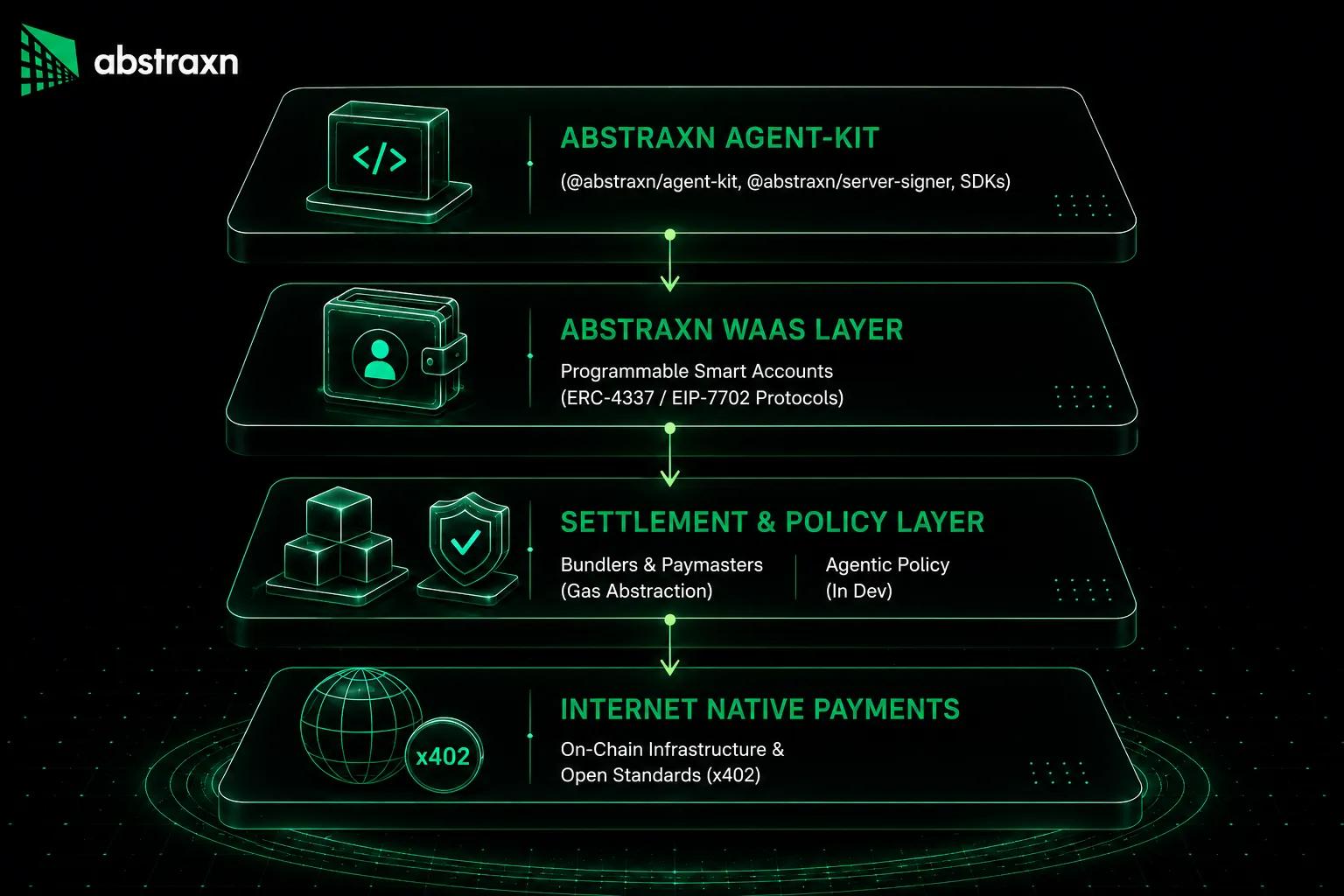
The platform maps directly to the neutral primitives of the agentic banking stack through its core product offerings:
- Abstraxn WaaS: This is the programmable account layer of the stack. It provisions enterprise-grade, secure smart accounts built on ERC-4337 and EIP-7702 architecture. Abstraxn WaaS allows agents to operate with dedicated non-custodial containers where wallet management and identity boundaries are explicitly enforced.
- The Settlement Layer: This functions as the transaction rail system. Abstraxn combines highly optimized Bundler, Relayer, and Paymaster architecture. The Paymaster serves as the critical gas-abstraction engine, allowing your agents to interact with smart contracts and send stablecoins without forcing developers to maintain native gas tokens across different chains.
- The Abstraxn Agent-Kit SDK: This provides the developer API surface. By exposing dedicated packages, including
@abstraxn/agent-kit,@abstraxn/server-signer, and@abstraxn/signer-react, builders can plug financial capabilities into an autonomous workflow with minimal setup.
Abstraxn unifies these features under a comprehensive vision known as the Four Powers: Identity (leveraging the open ERC-8004 standard), Wallet infrastructure (delivered via Abstraxn WaaS), Payments (utilizing internet native payments like the x402 standard for real-time per-request billing), and Policy enforcement (which handles runtime constraints and is currently in active development).
Developer Note: Abstraxn operates at the integration and orchestration layer. It exposes clean developer tooling over account abstraction, settlement, and policy primitives so builders work with outcomes rather than low-level plumbing. Cryptographic key custody and transaction signing are handled by the underlying signing infrastructure Abstraxn integrates with, not reimplemented by Abstraxn.
5. What building on it looks like
Integrating Abstraxn into an autonomous workflow follows a structured, programmatic experience. Developers can move an agent from pure reasoning to live economic execution in a few sequential steps:
- Initialize the smart account: Using the
@abstraxn/server-signer, the backend runtime generates a secure, unique smart account for the agent instance during deployment. - Fund the balance container: The application routes a pre-allocated balance of stablecoins into the newly provisioned Abstraxn WaaS account.
- Configure policy constraints: Developers define the boundaries of operation, specifying target contract addresses and maximum transaction thresholds.
- Execute and sponsor transactions: The agent encounters a resource requirement, such as querying a paid data source over HTTP 402 protocols. It requests payment execution through the SDK. The Abstraxn Settlement Layer bundles the transaction, applies gas sponsorship via the Paymaster, and settles the balance on-chain instantly.
Abstraxn has already processed [STAT TO VERIFY] total transactions across multiple production networks, maintaining a [STAT TO VERIFY] percent platform uptime while scaling enterprise agent deployments.
Key Takeaways
- Autonomy demands infrastructure: AI agents cannot scale if they are restricted by human-centric financial rails like credit cards and manual multi-factor authentication loops.
- Authority control is paramount: Shifting from traditional generative outputs to autonomous action means security must change from periodic compliance reviews to runtime policy enforcement.
- Smart accounts provide the boundary: Account abstraction forms the architectural bedrock for agentic banking, ensuring software can custody and move assets inside secure parameters.
- Gas abstraction removes friction: Production-grade execution requires paymaster systems that abstract blockchain complexities, allowing agents to pay for API usage seamlessly.
- Abstraxn delivers the full stack: By unifying Abstraxn WaaS, optimized settlement bundlers, and simple agent-kit SDK tools, the platform provides a production-ready solution for machine commerce.
Frequently Asked Questions
What is an agentic banking infrastructure API?
It is a dedicated developer interface that connects autonomous software agents to programmable financial systems, allowing them to verify account state, manage balances, and execute transactions without human interaction.
How is it different from a traditional banking API?
Traditional banking APIs are built for humans, requiring interactive confirmation steps, session-based authentication, and manual compliance checks. An agentic banking API is machine-native, built for real-time programmatic authorization, ephemeral identities, and autonomous runtime enforcement.
What primitives does an AI agent need to transact?
An agent requires a programmable account container to hold assets, automated transaction rails with gas sponsorship, cryptographically verifiable identity tracking, and strict policy guardrails to restrict spending authority.
How do agents pay transaction fees without holding tokens?
They utilize gas abstraction protocols powered by paymasters. The infrastructure provider or deploying organization sponsors the network fee behind the scenes, allowing the agent to transact strictly using stablecoins or standard business metrics.
Does this work across multiple chains?
Yes, modern agentic infrastructure stacks are built to support multi-chain operations, providing automated settlement layers that bridge transactions across dominant Ethereum Virtual Machine ecosystems and high-performance alternative ledgers.
Ready to build the future of autonomous commerce?
- Start Your Integration: Sign up for our 30-Day Free Trial to access the developer dashboard and stand up your first smart account.
- Architect for Scale: Talk to Our Experts to design a secure, high-throughput policy layer tailored to your enterprise workflows.
- Partnership Opportunities: For custom enterprise deployments, licensing structures, or ecosystem grants, Reach Out for Business Queries.
About the Author

Parth Chaudhary
Solution Architect
Parth Chaudhary is a Solution Architect at Antier, the team behind Abstraxn. He currently works at the intersection of account abstraction and agentic AI infrastructure, consistently shipping wallets, paymasters, identity primitives, and policy guardrails for autonomous agents in production. Find out more at abstraxn.com or easily spin up an agent at dashboard.abstraxn.com.