Web3 adoption rarely fails at the protocol layer.
It fails the moment a user is asked to “connect a wallet.”
Browser extensions, seed phrases, and external wallet flows introduce friction before users even understand the product they are onboarding into. For developers, this creates a tradeoff between decentralization ideals and practical usability.
Over the last few years, embedded wallets have emerged as the most reliable way to resolve this tension. Not as a UX shortcut, but as infrastructure designed specifically for predictable onboarding.
This blog explains why seamless Web3 onboarding starts with embedded wallets, what problem they actually solve, and how developers should think about embedded wallets as a service when building production applications.
The Onboarding Constraint in Web3 Applications
Most Web3 applications still rely on externally managed wallets as the default entry point. While familiar to crypto-native users, these flows introduce several constraints:
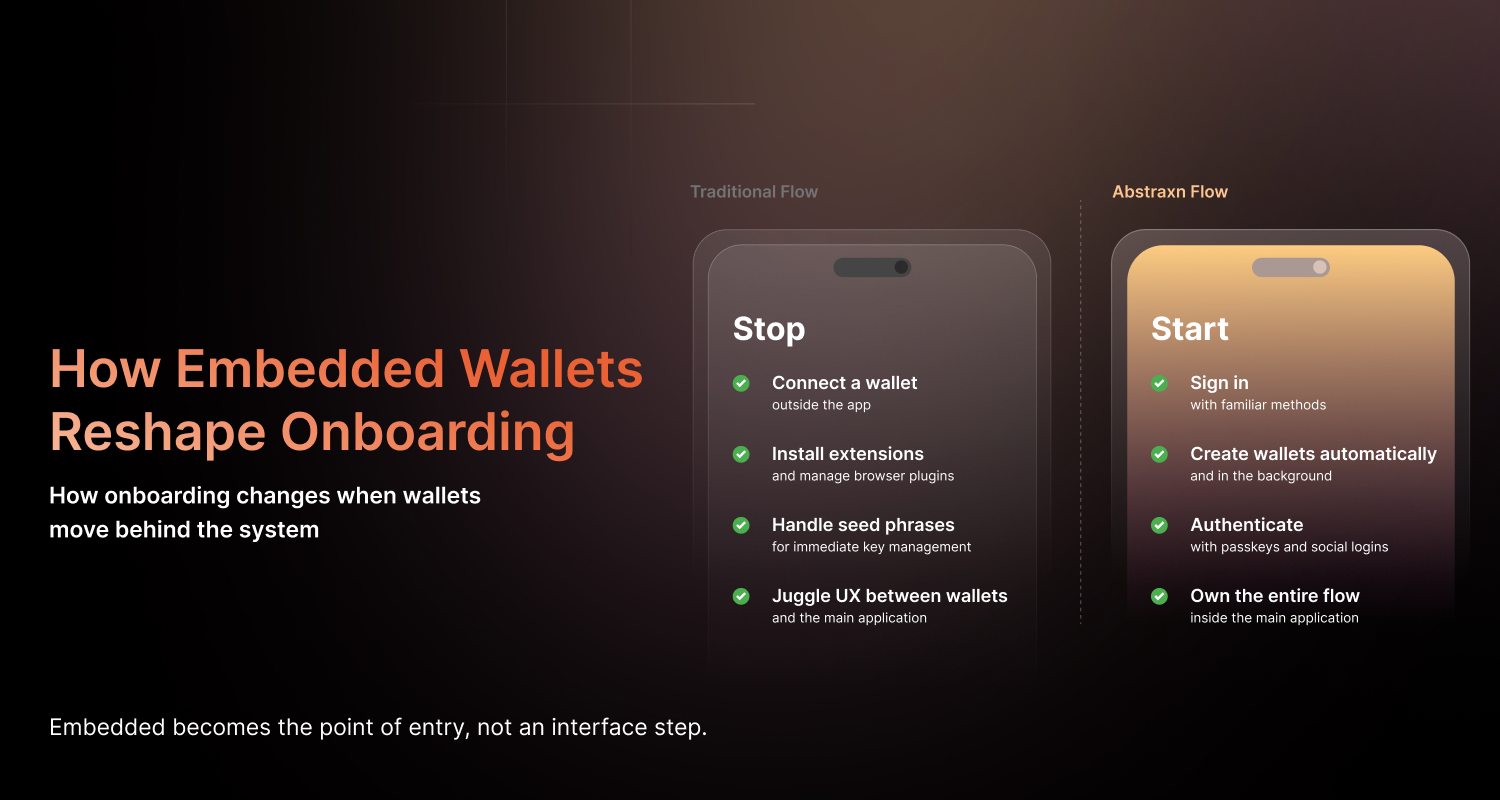
- Users must install a browser extension or mobile wallet
- Key management is exposed early in the journey
- Authentication is fragmented from the application UX
- Drop-off occurs before users experience core functionality
From a developer’s perspective, the issue is not philosophical. It is operational.
When onboarding depends on external tooling, the application gives up control over:
- Authentication flow
- First-time user experience
- Error handling
- UI consistency
As applications move beyond early adopters, this model becomes increasingly difficult to justify.
What Embedded Wallets Actually Change
Embedded wallets move wallet creation and authentication inside the application.
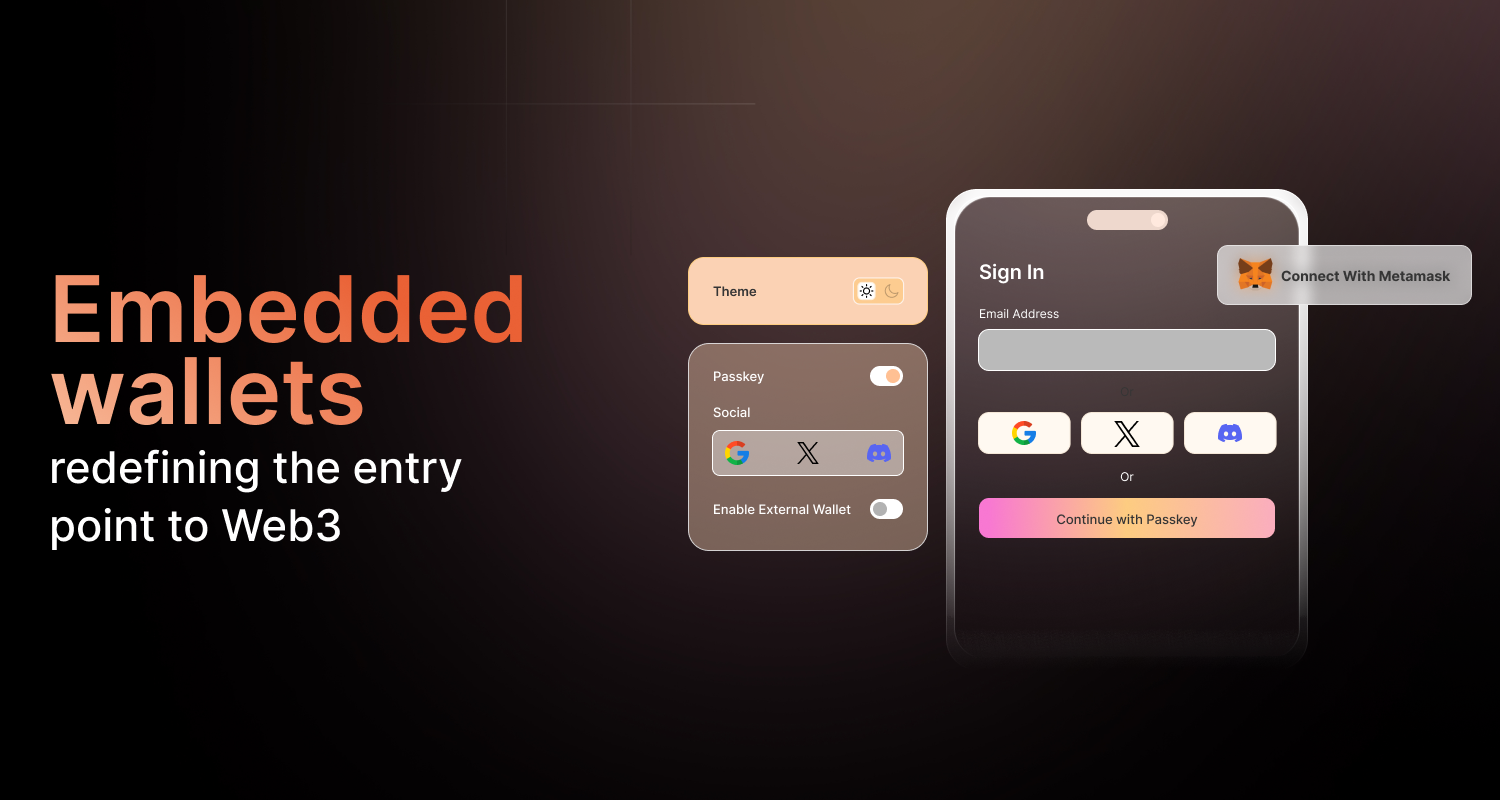
Instead of redirecting users to external wallets, the application provisions a wallet programmatically at the moment of login. Authentication uses familiar methods such as email or passkeys, while key management and transaction execution happen securely in the background.
This is the core shift:
Wallets stop being the entry point.
Onboarding becomes the entry point.
With embedded wallets:
- Users sign in before they ever think about wallets
- Wallets are created automatically, not manually
- The application owns the entire onboarding flow
For developers, this is not just a UX improvement. It is a change in architectural control.
Embedded Wallets as a Service: The Infrastructure Layer
Modern teams rarely build wallet systems from scratch. Instead, they rely on embedded wallets as a service infrastructure that handles provisioning, authentication, and execution while exposing clean SDKs to the application.
This model provides:
- Predictable wallet creation
- Standardized authentication flows
- Isolated environments per application
- Clear operational boundaries
Critically, this does not mean sacrificing control. A well-designed embedded wallet system allows developers to configure authentication behavior, enable or disable external wallets, and define how transactions are executed.
The application remains the owner of UX and logic. The infrastructure handles the complexity underneath.
Non-Custodial Embedded Wallets and Developer Trust
One common misconception is that embedded wallets imply custodial risk.
In practice, non-custodial embedded wallets rely on smart account architectures where users retain ownership of assets, even though key management is abstracted away from the UI.
The difference is not custody. It is exposure.
Instead of forcing users to manage keys directly on day one, non-custodial embedded wallets:
- Secure keys by default
- Abstract cryptographic complexity
- Allow progressive disclosure when users are ready
For developers, this aligns with how most products already operate. Authentication is familiar. Security is handled at the infrastructure layer. Control remains explicit.
Seamless Onboarding Is a System, Not a Feature
It is tempting to describe embedded wallets as a UX improvement. That framing is incomplete.
Seamless onboarding emerges when multiple systems work together:
- Authentication
- Wallet provisioning
- Account abstraction
- Transaction execution
Embedded wallets sit at the center of this system. They allow onboarding to be treated as a repeatable, predictable process not a fragile integration of third-party tools.
This is why embedded wallets increasingly appear as the foundation layer in production Web3 applications, rather than as optional enhancements.
Why Developers Are Moving Away from Extension-First Flows
Browser extensions still matter. They serve advanced users well.
But extension-first onboarding introduces constraints that are difficult to justify when building for scale:
- Extensions fragment the user journey
- Mobile onboarding becomes inconsistent
- UI ownership shifts outside the product
- Error states become harder to manage
Embedded wallets invert this relationship. External wallets become optional, not mandatory.
This allows teams to:
- Support crypto-native users when required
- Preserve embedded onboarding as the default
- Maintain consistent behavior across environments
The result is not exclusion, but flexibility.
Embedded Wallets as the Baseline, Not the Add-On
The most important mental shift is this:
Embedded wallets are no longer an optimization layer.
They are the baseline for onboarding.
Once wallet creation is handled inside the application:
- Authentication becomes predictable
- UX ownership remains internal
- Developers regain control over user entry
Everything else- account abstraction, gas sponsorship, transaction batching, builds on top of this foundation.
Abstraxn’s Approach to Embedded Onboarding
Abstraxn implements embedded wallets as production-grade onboarding infrastructure.
Wallets are provisioned directly inside applications using familiar authentication such as email or passkeys. Creation happens automatically on first user interaction, without browser extensions or exposed seed phrases.
From an architectural standpoint, wallet provisioning, authentication, and execution remain inside the application boundary. This keeps onboarding predictable and fully under developer control, rather than delegated to external tooling.
Abstraxn’s embedded wallets use smart account architectures, allowing teams to adopt account abstraction progressively while keeping onboarding stable by default.
Where This Leads Next
Handling onboarding correctly exposes the next set of constraints developers encounter:
- Transaction failures
- Gas complexity
- Execution reliability
- Operational cost management
These problems do not appear until onboarding friction is removed.
In the next blog, we will move forward from wallet creation to what happens after the first transaction,and why smart accounts become unavoidable once applications scale beyond basic interactions.
Once onboarding is handled, execution becomes the real bottleneck.
Closing Thought
Seamless Web3 onboarding does not start with better messaging or cleaner UI.
It starts with embedded wallet systems designed to provision accounts predictably, authenticate users securely, and keep control where it belongs, with the application.
Everything else builds on that decision.