
Smart accounts change how transactions are created and executed. Instead of broadcasting transactions directly to the network, applications generate structured execution requests that require coordinated infrastructure to reach on-chain finality.
This shift introduces more than a new transaction format. It introduces a new execution model.
In this model, transaction processing is no longer handled by the user or the application alone. It is handled by dedicated infrastructure that validates, sequences, and executes requests reliably.
Account abstraction bundlers operate within this execution layer. But in production environments, bundlers do not operate in isolation. They are part of a broader system that determines how reliably smart account transactions execute at scale.
What Is an Account Abstraction Bundler
An account abstraction bundler is an execution infrastructure responsible for processing and submitting UserOperations for smart accounts.
Applications generate UserOperations as structured execution requests. These requests define intent, including validation logic and execution parameters. However, they are not directly compatible with the network’s transaction format.
Bundlers receive these operations, validate them, and package them into transactions that can be executed on-chain through the EntryPoint contract.
From an architectural standpoint, bundlers act as the translation and execution layer between application-defined intent and network-level transaction processing.
Why Bundlers Exist in Account Abstraction
Account abstraction separates transaction intent from execution.
Users and applications define what should happen, but they do not directly construct or submit the final transaction. This creates a structural gap between application logic and blockchain execution.
Bundlers resolve this gap.
They convert UserOperations into executable transactions, enabling smart accounts to function within existing network constraints. Without bundlers, structured execution requests cannot reach on-chain finality.
This makes bundlers a required component of any account abstraction system. They ensure that application-defined execution flows are translated into network-compatible transactions without requiring applications to manage low-level transaction mechanics.
How Account Abstraction Bundlers Work
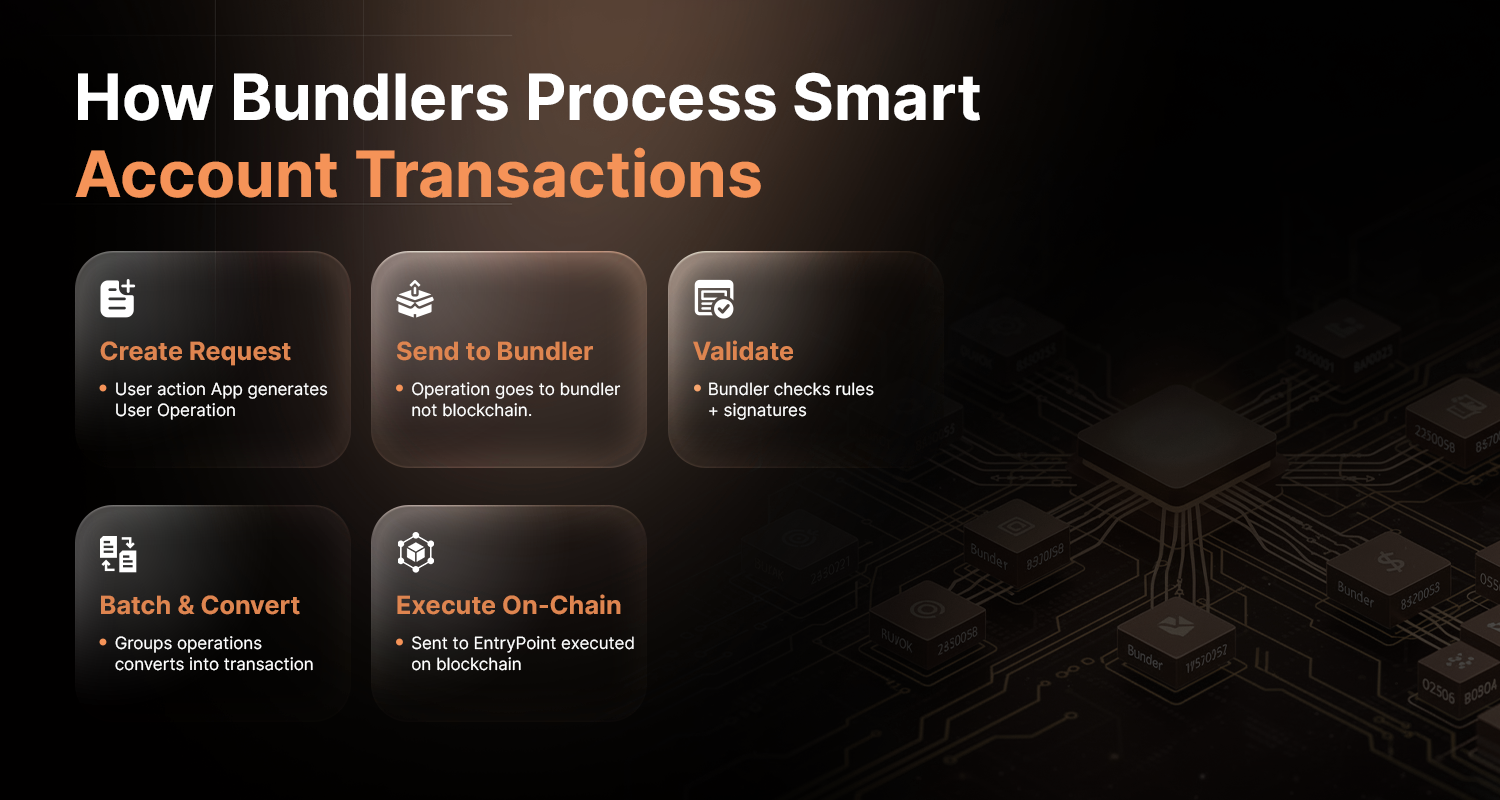
Bundlers operate through a structured execution pipeline that ensures UserOperations are processed consistently.
1. UserOperation creation
The application generates a UserOperation based on user interaction or backend logic.
2. Submission bundler infrastructure
The operation is sent to a bundler instead of being broadcast directly to the network.
3. Validation
The bundler verifies the operation, including signature checks and execution constraints defined by the smart account.
4. Batching and sequencing
Multiple operations are grouped together to improve execution efficiency and reduce on-chain overhead.
5. Transaction construction
The bundler converts the batch into a network-compatible transaction.
6. Submission to EntryPoint
The transaction is submitted to the EntryPoint contract, which executes each operation.
7. On-chain execution
Operations are processed according to their defined logic, and finality is achieved.
This pipeline allows applications to define execution intent while delegating transaction processing to infrastructure.
The Limitation of Standalone Bundler Infrastructure
Most bundler implementations are exposed as isolated services.
They process UserOperations and submit transactions, but they operate independently of other execution components such as paymasters and relayers. This creates an integration model where developers are responsible for orchestrating multiple systems:
- Bundler for execution
- Paymaster for gas policy
- Relayer for transaction routing
Each component introduces its own configuration, API surface, and operational behavior.
This fragmentation increases integration complexity and creates coordination overhead at the application layer. Execution reliability becomes dependent on how well these independent systems are aligned.
For production environments, especially those operating at scale, this model introduces avoidable variability in transaction execution.
Execution Infrastructure as a Coordinated System
In production systems, execution infrastructure cannot operate as disconnected services.
Transaction execution depends on multiple coordinated decisions:
- How gas is handled
- How transactions are routed
- How execution is sequenced
- How failures are retried
When bundlers operate without awareness of these factors, applications must manage this coordination themselves.
A more stable approach is to treat execution as a single system, where bundling, gas policy, and transaction routing are aligned by design.
This reduces integration overhead and ensures that execution behavior remains consistent across all transactions.
Bundlers in the Abstraxn Execution Stack
Within Abstraxn, bundlers operate as part of a unified execution layer alongside relayers, paymasters, and smart accounts.
These components are not exposed as independent services. They are architected to function as a coordinated system.
This allows execution flows to operate with shared context:
- Bundlers process operations with awareness of gas policies defined by paymasters
- Transaction routing aligns with relayer infrastructure
- Execution behavior remains consistent across all components
From an integration perspective, this removes the need to orchestrate multiple APIs or manage cross-service dependencies.
Applications interact with execution infrastructure as a single system rather than assembling it from separate components.
Enterprise Requirements for Bundler Infrastructure
In enterprise environments, execution infrastructure is evaluated based on reliability, control, and auditability.
Bundlers must operate within systems that provide:
- Deterministic execution
Transactions should execute predictably under defined conditions.
- Infrastructure isolation
Execution environments should be controlled and not dependent on shared public infrastructure.
- Transaction traceability
Every execution request should be observable and auditable.
- Operational consistency
Execution behavior should remain stable across scale and varying network conditions.
Most bundler services are optimized for developer accessibility. They focus on ease of integration but do not address enterprise-level execution requirements.
Abstraxn positions bundler infrastructure within an environment designed for controlled execution. This aligns transaction processing with the expectations of financial systems and regulated platforms.
Abstraction Depth and Invisible Execution Infrastructure
A key distinction in execution design is where complexity resides. Most bundler implementations assume that developers understand the mechanics of account abstraction, including UserOperations, EntryPoint interactions, and execution flows.
Abstraxn shifts this complexity away from the application layer.
Execution infrastructure is exposed through SDKs that allow developers to initiate transactions without directly interacting with bundler mechanics. The system handles operation construction, validation, and submission internally.
This is not only a developer experience improvement. It is an architectural decision that defines how systems are built.
Applications operate at the level of business logic, while execution infrastructure operates independently as a controlled system.
This allows blockchain interactions to behave like standard application actions, without exposing underlying protocol complexity.
Conclusion
Account abstraction bundlers are essential for enabling smart account transactions. They process structured execution requests and ensure that these requests are translated into valid on-chain transactions.
However, in production environments, bundlers cannot be treated as standalone components.
Execution reliability depends on how bundlers interact with gas policies, transaction routing, and system-level coordination. Fragmented infrastructure increases integration complexity and introduces variability into execution behavior.
Abstraxn approaches bundlers as part of a unified execution system. By aligning bundlers with relayers, paymasters, and smart accounts, the platform ensures that transaction execution operates predictably and consistently.
This allows applications to integrate smart account functionality without managing execution complexity, while maintaining the level of control and reliability required for production systems.