
The Web3 Onboarding Problem
User onboarding remains one of the most persistent barriers to Web3 adoption. Many blockchain applications attract interest but struggle to convert new users into active participants. A significant portion of this drop-off occurs during the first interaction with wallet infrastructure
Industry research indicates that 60–90% of potential users abandon Web3 onboarding before completing their first transaction, with wallet setup and funding cited as the primary sources of friction.¹ New users are typically required to install a wallet, manage a seed phrase, acquire native tokens for gas fees, and approve multiple transactions before experiencing any application functionality.
For developers building consumer or enterprise applications, this process introduces a fundamental challenge. Product onboarding that depends on external wallet setup often interrupts the user journey before meaningful interaction begins.
This issue is frequently approached as a design problem. In practice, however, the root cause lies deeper in the architecture of traditional Web3 wallets.
Understanding the difference between Externally Owned Accounts (EOAs) and smart accounts helps explain why onboarding friction persists- and how modern wallet infrastructure can reduce it.
EOAs and the Traditional Web3 Wallet Model
Most blockchain users interact with networks through Externally Owned Accounts (EOAs). An EOA is a wallet controlled directly by a private key. Transactions are signed by the account holder and submitted to the network using that key.
This model prioritizes cryptographic ownership and decentralization. It works well for users who are already familiar with blockchain systems. However, EOAs introduce several operational requirements that affect onboarding.
EOA-based onboarding typically involves:
- Creating or importing a wallet
- Generating and storing a recovery phrase
- Installing a browser extension or mobile wallet
- Funding the wallet with native tokens
- Connecting the wallet to an application
- Signing transactions to interact with the product
Each step introduces potential friction. For new users encountering blockchain infrastructure for the first time, managing private keys and recovery phrases can create hesitation. Funding a wallet before interacting with an application adds another layer of complexity.
These constraints explain why many applications experience a drop-off before users complete their first on-chain action.
EOAs were designed for secure ownership of digital assets. They were not designed to support application-native onboarding flows.
Where EOA-Based Onboarding Breaks
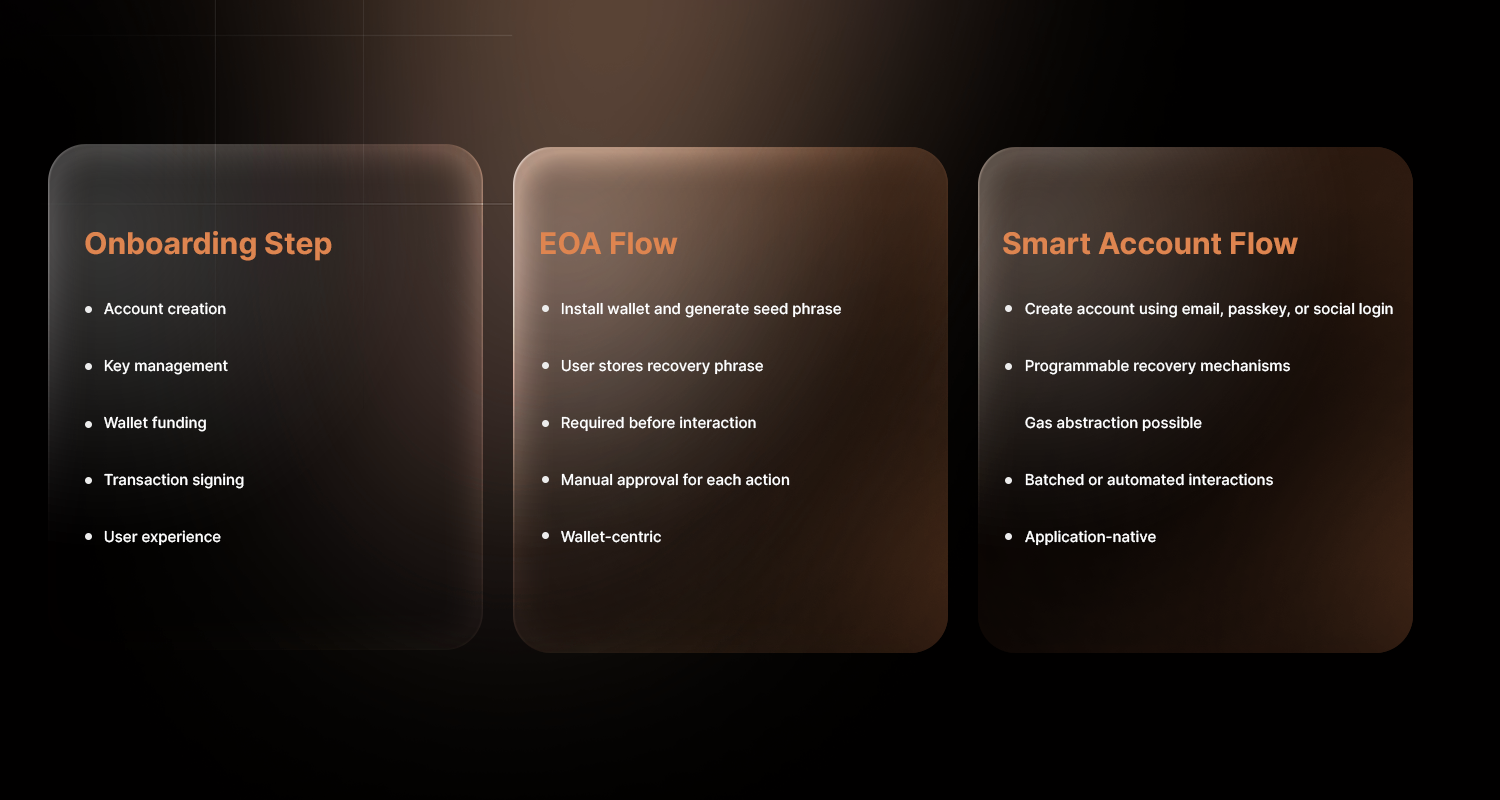
To understand how onboarding friction develops, consider the typical steps required when a new user enters a Web3 application using an EOA wallet. 1. Wallet installation Users must first install a wallet extension or mobile application. This step introduces an external dependency before the product experience begins. 2. Seed phrase management The wallet generates a recovery phrase that the user must store securely. For many users, this requirement creates immediate uncertainty about security and responsibility. 3. Wallet funding Before interacting with most applications, users must acquire cryptocurrency to pay transaction fees. This often requires navigating an exchange, purchasing tokens, and transferring them to the wallet. 4. Application connection Users connect the wallet to the application through a wallet interface, often leaving the application environment in the process. 5. Transaction approvals Each interaction with the application requires manual transaction signatures. At multiple points in this flow, the onboarding experience pauses while users perform tasks unrelated to the application itself. Studies examining Web3 onboarding flows consistently identify wallet creation and funding as the stages where the largest percentage of users abandon the process.² The result is a structural mismatch between traditional wallet architecture and modern product onboarding. Smart accounts introduce a different model for managing blockchain interactions. Instead of relying solely on private keys, smart accounts use smart contract logic to control account behavior This architecture enables programmable wallet functionality, allowing developers to design onboarding flows that more closely resemble traditional application experiences. Smart accounts can support features such as: These capabilities move complexity away from the user interface and into infrastructure. From an onboarding perspective, this shift is significant. Users can create and access accounts using familiar authentication systems while the underlying wallet logic operates through programmable infrastructure. Instead of requiring users to manage cryptographic primitives directly, smart accounts allow developers to build application-native onboarding experiences. The architectural differences between EOAs and smart accounts become clearer when comparing the onboarding process side by side. In the EOA model, the wallet acts as the central interface for blockchain interaction. The application depends on the wallet to execute transactions and manage keys. With smart accounts, the application can integrate wallet infrastructure more directly into its product flow. Authentication, account provisioning, and transaction handling become programmable components rather than external dependencies. This architectural shift reduces the number of steps required before users can interact with the application itself. Another important capability introduced by smart accounts is smart accounting, where transaction behavior is governed by programmable account logic. Smart accounting enables: For applications with complex user interactions,such as gaming platforms, financial applications, or digital marketplaces, these capabilities significantly reduce the number of manual approvals required during normal usage. Research examining smart account implementations has shown that batched transactions and permissioned execution flows can reduce repetitive signing prompts in multi-step interactions. This has direct implications for product metrics: In practice, the architecture of the wallet determines how much friction users experience when interacting with blockchain systems. While smart accounts improve onboarding flows, they also introduce additional infrastructure requirements. Smart account execution typically relies on supporting systems such as: : These components operate together to support the programmable behavior of smart accounts. For development teams, managing this infrastructure independently can introduce operational complexity. As a result, many applications rely on specialized wallet infrastructure platforms to integrate these systems into their architecture. For teams building Web3 applications, improving onboarding completion requires more than interface design changes. It requires infrastructure capable of supporting programmable wallet models. Abstraxn provides wallet infrastructure designed to support this architecture. Through embedded wallet provisioning, smart account infrastructure, and transaction execution systems, developers can integrate blockchain functionality directly into application onboarding flows. Wallet creation can occur during user signup. Authentication can rely on familiar mechanisms such as passkeys or social login. Transaction execution can operate through infrastructure layers rather than requiring users to manage wallet operations directly. The result is an onboarding experience that resembles modern applications while maintaining the security and transparency of blockchain systems. For products focused on adoption and user retention, the architecture of wallet infrastructure plays a central role. Reducing onboarding drop-off begins with designing systems that allow users to interact with blockchain applications without encountering unnecessary operational complexity.Smart Accounts and Programmable Wallet Infrastructure
A Comparative Case Study: EOAs vs. Smart Accounts
Smart Accounting and Product-Level Transaction Control
Infrastructure Requirements for Smart Accounts
Enabling Seamless Onboarding with Smart Account Infrastructure